Scientific article · Sources checked October 21, 2026
Salicylic Acid in a Split-Face Trial: Lesion Counts and Pore-Size Claims
A randomized, 28-day comparison found similar reported lesion reductions with two topical treatments. Its paired design is useful, but the results do not establish equivalence, permanent pore changes, or benefits for every salicylic acid formula.
Editorial source review, with no clinician sign-off or firsthand treatment experience claimed.
A small acne study offers a useful lesson in reading pore-related claims: counting fewer clogged lesions is not the same as measuring smaller pores. In a randomized split-face trial, 31 participants completed 28 days of treatment with a modified 2% salicylic acid cream on one side and a benzoyl peroxide–adapalene gel on the other. Both sides showed reductions in inflammatory and noninflammatory acne lesions. The reported differences between treatments were not statistically significant.
The strongest conclusion is narrower than a claim that the treatments are interchangeable or that salicylic acid permanently shrinks pores. This analysis uses the indexed primary report abstract and available official FDA material, not a review of the full study protocols or supplements. The distinction matters because the abstract supplies useful numerical results but leaves important questions about precision, adverse events, enrollment, and analysis unanswered.
In this article
Study facts at a glance
Study population and duration: Thirty-one people with mild to moderate facial acne completed a randomized, open-label, single-center, split-face study lasting 28 days. Source 1
Treatments compared: The study compared topical 2% supramolecular salicylic acid cream with 5% benzoyl peroxide plus 0.1% adapalene gel; the abstract's objectives contain a conflicting 0.01% adapalene figure. Source 1
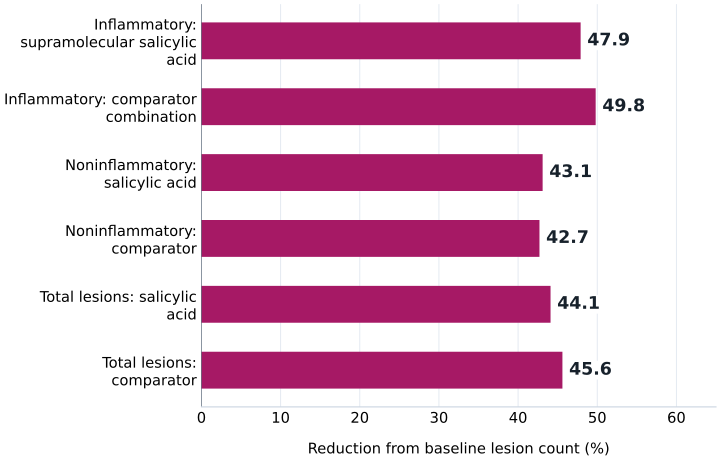
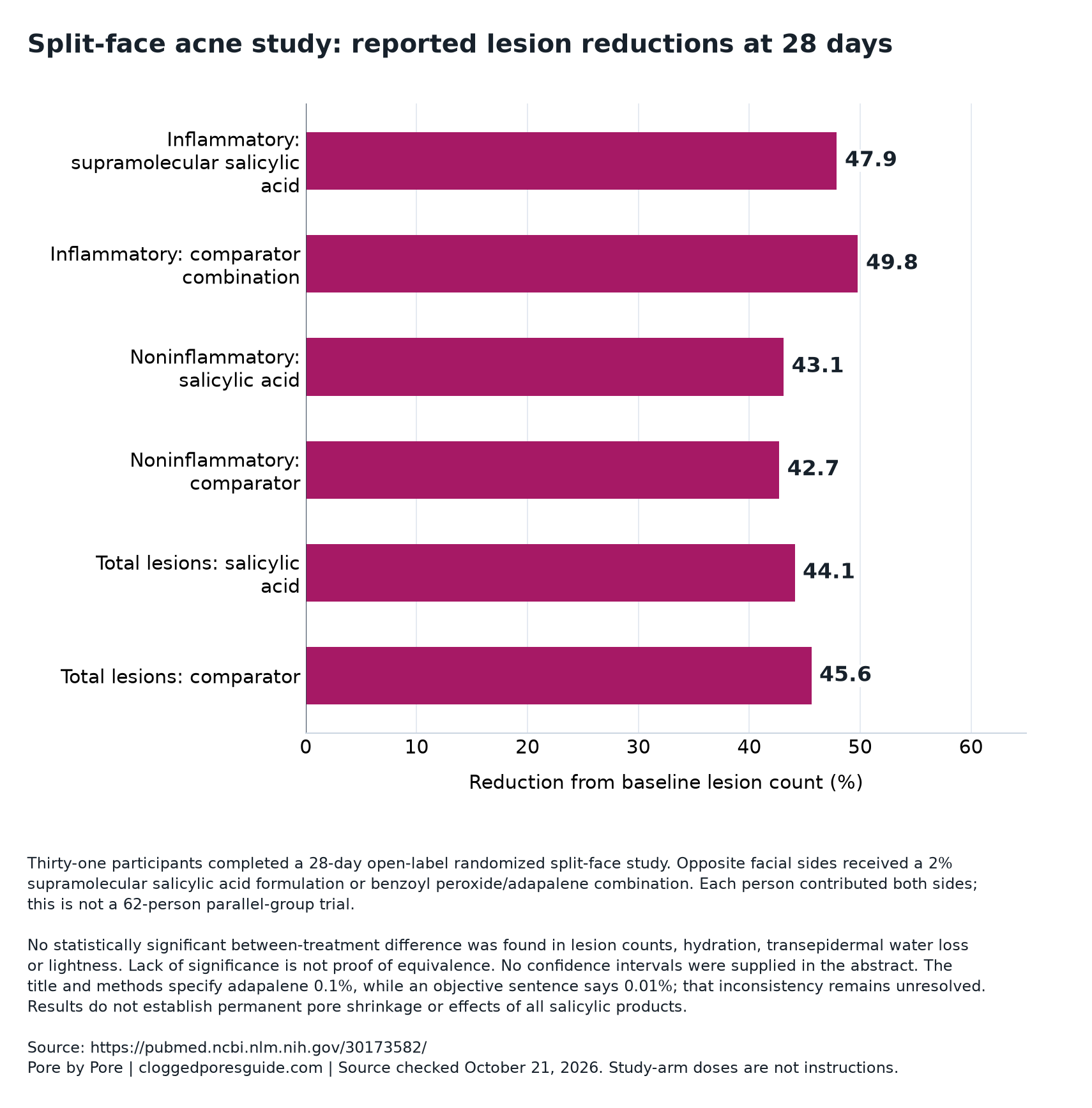
Noninflammatory lesion counts: Reported reductions at day 28 were 43.1% with salicylic acid and 42.7% with the comparator, a descriptive difference of 0.4 percentage points. Source 1
Statistical interpretation: Between-treatment lesion comparisons were not statistically significant. Confidence intervals were not available in the abstract, and formal equivalence was not established. Source 1
Pore-size evidence: The reported endpoints were acne lesion counts and selected skin measurements, not visible pore dimensions or permanent pore shrinkage. Source 1 Source 3
What the trial actually compared
Participants had mild to moderate facial acne. Investigators randomly assigned 2% supramolecular salicylic acid cream to one side of each face and the combination gel to the opposite side for 28 days. Supramolecular salicylic acid was described as a modified preparation. The percentages identify the study formulations; they are not instructions for assembling a similar regimen from separate products.
There is a concentration inconsistency within the indexed report: its title and methods identify 0.1% adapalene with 5% benzoyl peroxide, while the objectives also state 0.01%. This article uses the title-and-methods figure while preserving that discrepancy. The abstract reports investigator assessments at baseline, day 14, and day 28. It lists lesion counts and skin measurements but does not clearly designate a single primary endpoint, so none should be retroactively selected.
Read the underlying chart data: download CSV or download the source-labeled chart.
Why 31 paired faces are not 62 independent patients
A split-face design makes each participant their own comparator. Age, general hormonal environment, and many everyday exposures are shared by both sides. This can reduce some of the person-to-person variation that complicates a trial assigning different people to different creams. Random allocation of the treated side also helps avoid systematically favoring one side of the face.
But two sides belonging to one person are related observations, not independent patients. The study therefore had 31 completers, not 62 independent participants. A valid analysis needs to account for this pairing; the abstract does not provide enough statistical detail to audit how that was done. Nor does it report how many people originally enrolled, making the number or reasons for withdrawals impossible to reconstruct.
The study was open-label, meaning treatment identity was not concealed as in a blinded trial. Knowledge of treatment could influence application behavior, symptom reporting, or assessments. Randomization strengthens the comparison, but it does not remove those possible influences. Conduct at one center also leaves unanswered how consistently these findings would appear in other clinical settings.
Reading the lesion reductions without changing their meaning
At day 28, inflammatory lesions—reported as papules and pustules—declined by 47.9% on the salicylic acid side and 49.8% on the comparator side. Noninflammatory lesions declined by 43.1% and 42.7%, respectively. Total lesions declined by 44.1% and 45.6%. These are reductions in counted lesions, not percentages of participants whose acne cleared.
For a worked illustration, a 43.1% reduction from a hypothetical starting count of 100 lesions would leave 56.9 lesions in an average-count calculation. Actual individuals have whole-number counts, and the study's baseline counts are not available here. The example explains the percentage; it does not reconstruct a participant's result or establish how many lesions were prevented.
The differences below are percentage-point differences between reported reductions. They are not relative risks, probabilities of success, or evidence that one treatment consistently outperformed the other. Total-lesion reduction also combines lesion categories, so it should not be treated as an additional independent confirmation of each category's result.
Reported day-28 lesion reductions; differences are descriptive, not statistically established advantages.
| Lesion category | 2% supramolecular salicylic acid | 5% benzoyl peroxide + 0.1% adapalene |
|---|---|---|
| Inflammatory lesions | 47.9% reduction | 49.8% reduction; 1.9 percentage points greater |
| Noninflammatory lesions | 43.1% reduction | 42.7% reduction; 0.4 percentage points smaller |
| Total lesions | 44.1% reduction | 45.6% reduction; 1.5 percentage points greater |
A nonsignificant difference is not proof of equivalence
The abstract reports that the lesion-count comparisons had P values above 0.05. In plain language, the reported analysis did not establish a statistically significant difference between sides. That is compatible with treatments having similar effects, but it can also occur when a study has too little information to distinguish a meaningful difference from random variation.
Formal equivalence requires more than nearby averages: investigators need a justified margin defining how different treatments may be while still counting as equivalent, together with an analysis demonstrating adequate precision around the difference. The accessible abstract does not establish those conditions. It also provides no confidence intervals, which would show the range of differences reasonably compatible with the data.
The most defensible description is therefore that the observed reductions were close in this small, short study. Calling the preparations equally effective would erase uncertainty. Likewise, the absence of an untreated or vehicle-only side means this trial principally addresses a comparison between two active formulations, rather than isolating each formulation's effect against no active treatment.
A counted comedone is not a pore-diameter measurement
Noninflammatory acne lesions include comedones, commonly discussed as blackheads and whiteheads. Their number is a different outcome from the diameter, area, or visual prominence of pore openings. A side of the face can have fewer counted lesions without the study demonstrating that its visible pores became smaller. Our guide to visible pores versus blackheads develops that distinction.
No pore-dimension endpoint appears in the indexed abstract. The study also does not report permanent pore closure, scar improvement, or a proportion of patients achieving complete clearance. Even if clearing a plug changes how an opening looks, that possibility is not a measured structural result here. It would need its own defined photographic or instrumental assessment.
This is also why the word exfoliation cannot substitute for an outcome. FDA's cosmetic BHA discussion identifies salicylic acid with exfoliation, but that background does not establish a precise pore-size benefit. The guide to salicylic-product claims and visible pores helps separate an ingredient description from a demonstrated appearance result.
What hydration, water loss, and color measurements add
Investigators measured skin water content and transepidermal water loss, or TEWL. TEWL describes water passing outward through the skin and is used in assessing barrier function. They also measured L*, an indicator of lightness, and a*, an indicator relevant to redness. These measurements broaden the study beyond acne counts, but each addresses a separate question.
The abstract reports no statistically significant between-side differences in hydration, TEWL, lightness, or redness. It does not provide the numerical changes or confidence intervals needed to judge how close the sides were. Importantly, no difference between sides does not establish that neither side changed from baseline, that neither treatment irritated skin, or that everyone tolerated both equally well.
The color measurements also should not be converted into evidence of fading acne marks or improving scars. No such clinical result is reported. A useful pore-product progress record keeps lesion counts, appearance, and comfort in separate fields; interpreting a study benefits from the same separation rather than collapsing several measurements into an overall promise of better skin.
Two other trials asked different salicylic acid questions
A separate 12-week randomized, double-blind trial enrolled 37 volunteers and compared chloroxylenol 0.5% plus salicylic acid 2% cream with benzoyl peroxide 5% gel. Its inflammatory and noninflammatory lesion reductions were numerically close between groups, without statistically significant between-group differences. Because salicylic acid was combined with another active ingredient, the findings cannot be assigned to salicylic acid alone.
Another randomized, single-blind, 12-week study enrolled 49 patients and tested adding salicylic acid to a clindamycin–benzoyl peroxide regimen. It reported better lesion-count results with the addition, but the abstract provides no effect sizes or confidence intervals. It also reports more mild to moderate transient dryness. These studies support distinct formulation-specific questions, not a pooled claim that all salicylic acid products produce the same result.
The separate analysis of the combination-cream trial examines the first comparison in more detail. Across these reports, duration, ingredients, blinding, and the unit of comparison differ. A 12-week result from separate treatment groups is not a direct extension of a 28-day within-person result.
Three randomized studies, with different formulations and scientific questions.
| Study and design | Comparison | Key finding and boundary |
|---|---|---|
| Split-face study; 31 completers; 28 days; open-label | 2% supramolecular salicylic acid versus benzoyl peroxide–adapalene | Close reported lesion reductions; no significant between-side differences; not formal equivalence |
| Combination-cream study; 37 volunteers; 12 weeks; double-blind | Chloroxylenol 0.5% + salicylic acid 2% versus benzoyl peroxide 5% | Inflammatory reductions 62% versus 60%; noninflammatory 56% versus 54%; no significant lesion-count differences |
| Addition study; 49 enrolled; 12 weeks; single-blind | Salicylic acid added to clindamycin–benzoyl peroxide versus that regimen alone | Better reported lesion-count results but more transient dryness; effect sizes and salicylic acid concentration unavailable in abstract |
Safety findings are narrower than a general reassurance
The split-face abstract says investigators assessed side effects, but it does not supply detailed adverse-event frequencies. Its nonsignificant redness and barrier comparisons cannot fill that gap. In the separate chloroxylenol–salicylic acid study, erythema and photosensitivity were reported less often than with benzoyl peroxide at week 12, without frequencies in the abstract. In the addition study, dryness was more frequent with the salicylic acid-containing regimen.
Official FDA information adds a different safety perspective. The acne monograph warns that combining topical acne medicines can increase dryness and irritation. FDA also distinguishes ordinary local irritation from rare serious hypersensitivity reported with some products containing salicylic acid or benzoyl peroxide. The responsible ingredient—active, inactive, or a combination—was not established.
FDA advises stopping the product and seeking emergency care for throat tightness, breathing difficulty, faintness, or swelling of the eyes, face, lips, or tongue. Historical spontaneous reports cannot provide an incidence rate without a denominator of exposed users. Neither those reports nor this small trial establish a product-by-product allergy ranking, and a sensitivity check does not guarantee that a later reaction will not occur.
Why a matching percentage does not establish a matching product
FDA's OTC acne monograph lists salicylic acid at 0.5%–2% and benzoyl peroxide at 2.5%–10%, subject to all applicable conditions. A concentration appearing within those ranges is not product-specific approval and does not establish that a retail product matches a clinical formulation. The monograph addresses acne uses, including blackheads and whiteheads, not permanent pore-size change.
Here the tested salicylic acid preparation was a modified cream, while the comparator was a combination gel. The study cannot separate the contributions of the active ingredients from every other formulation difference. Nor does its result automatically transfer to cleansers, ordinary solutions, compounded preparations, or oral routes. The product-format guide offers a practical way to keep these categories distinct.
Editorial interpretation: a clinical result and a service contract answer different questions. Someone evaluating an online offer can consult the Likeness Rx documentary review to check payment and follow-up terms. That link does not establish that the provider supplies the studied preparation, treats the same population, or produces the trial's outcomes.
What a stronger follow-up study would need to resolve
The report itself presents the trial as pilot evidence supporting larger studies. A stronger follow-up would report the enrollment denominator, withdrawals and reasons, baseline counts, application details, and a clearly prespecified primary endpoint. It would also explain how the paired observations were analyzed and supply confidence intervals for the between-treatment differences.
Longer observation would help answer whether the initial reductions persist and how tolerability develops beyond four weeks. If the research question concerns visible pores, investigators would need to define and measure pore appearance directly rather than infer it from comedone counts. If the question is equivalence, an adequately justified equivalence margin and appropriate design would be necessary.
Funding and sponsor information are not available in the accessed abstract, so sponsor involvement cannot be characterized. The absence of those details is not evidence of misconduct or independence. Together, these unresolved questions explain why the trial is informative as a small comparative experiment but insufficient as a universal claim about salicylic acid, long-term safety, or permanent changes in pore anatomy.
Questions about the evidence
Did salicylic acid outperform benzoyl peroxide plus adapalene?
No statistically significant superiority was reported. The noninflammatory lesion reduction was slightly larger with salicylic acid, while inflammatory and total reductions were slightly larger with the comparator. These small descriptive differences do not establish a winner. The study also did not establish formal equivalence.
Does a 43.1% reduction mean 43.1% of participants cleared their blackheads?
No. It refers to a reported reduction in noninflammatory lesion counts, not the percentage of people who cleared. The abstract does not supply a participant-clearance rate or separate numerical results for blackheads and whiteheads. It also does not report how many individual participants improved by a particular amount.
Can the results be applied to any product labeled 2% salicylic acid?
Not automatically. The trial tested a specific modified salicylic acid cream. Matching the active-ingredient percentage does not establish matching formulation, skin exposure, use conditions, or outcomes. FDA monograph conformity also involves more than concentration and is not confirmation that a product reproduces this trial.
Did the skin measurements prove that the treatments caused no irritation?
No. The abstract reports no significant between-side differences in hydration, water loss, lightness, or redness. That does not prove absence of irritation, and detailed adverse-event counts are unavailable. Official warnings about local irritation and rare serious hypersensitivity remain separate from these short-term comparisons.
How much does four weeks tell us about lasting improvement?
It describes the early comparison through day 28. The abstract does not establish maintenance of benefit, recurrence after treatment, long-term tolerability, or permanent pore changes. Twelve-week studies provide additional acne evidence, but their different combinations and designs prevent treating them as follow-up observations of this same formulation.
What this evidence supports
This trial offers preliminary, formulation-specific evidence that two active topical treatments produced close reported acne-lesion reductions over 28 days in 31 completers. Randomized within-person comparison is a meaningful strength. Open-label assessment, short follow-up, unavailable confidence intervals, and incomplete reporting limit the inference. For pore-related claims, the decisive boundary is the endpoint: fewer noninflammatory lesions were counted, but smaller visible pores were not measured. The result supports further comparative research, not claims of universal interchangeability or permanent pore shrinkage.
Research access and limitations
The clinical analysis relies on indexed primary report abstracts; full protocols, supplements, and detailed statistical methods were not examined. Official FDA material supplies regulatory and safety context rather than additional efficacy evidence. The split-face abstract contains an adapalene concentration discrepancy and does not provide enrollment totals, detailed adverse-event frequencies, confidence intervals, or sponsor information.
Sources behind this reading
- Efficacy and safety of 2% supramolecular salicylic acid compared with 5% benzoyl peroxide/0.1% adapalene in the acne treatment: a randomized, split-face, open-label, single-center study. ↗Indexed primary study abstract · Checked October 21, 2026
- FDA: beta hydroxy acids in cosmetics ↗Official FDA consumer background page, complete text read · Checked October 21, 2026
- FDA OTC monograph M006: topical acne drug products ↗Official six-page administrative order, all sections read · Checked October 21, 2026
- Comparison of chloroxylenol 0.5% plus salicylic acid 2% cream and benzoyl peroxide 5% gel in the treatment of acne vulgaris: a randomized double-blind study. ↗Indexed primary study abstract · Checked October 21, 2026
- Efficacy of the addition of salicylic acid to clindamycin and benzoyl peroxide combination for acne vulgaris. ↗Indexed primary study abstract · Checked October 21, 2026
- FDA safety communication: serious hypersensitivity to some OTC acne products ↗Official FDA Spanish communication; entire safety notice and data summary read · Checked October 21, 2026