Scientific article · Sources checked October 21, 2026
Salicylic Combination Cream: What a 37-Person Trial Counted
A 12-week comparison found similar acne-lesion reductions with a salicylic acid combination cream and benzoyl peroxide gel. The result concerns two complete formulations—not salicylic acid alone or visible pore dimensions.
Editorial source review, with no clinician sign-off or firsthand treatment experience claimed.
A pore-care label may cite a salicylic acid study without explaining whether its outcome was fewer acne lesions or a change in pore appearance. In 37 volunteers, a cream containing chloroxylenol 0.5% plus salicylic acid 2% was compared with benzoyl peroxide 5% gel. Both groups had substantial reductions in inflammatory lesions and comedones after 12 weeks. Those findings concern acne lesions, including blackheads and whiteheads. They do not establish that pore openings became smaller, that everyone cleared, or that any product with 2% salicylic acid would perform the same way.
The study is informative because it used random allocation, double blinding, an active comparator, and repeated lesion counts. It is limited because it compared small groups and changed several formulation features at once. This analysis uses the indexed primary report abstracts for three clinical studies and the available official FDA material; it does not claim examination of the clinical full texts or supplements. Together, these records help separate credible evidence of lesion reduction from broader claims about appearance, tolerability, and interchangeable products.
In this article
Study facts at a glance
Main comparison: Thirty-seven volunteers were randomized to benzoyl peroxide 5% gel or chloroxylenol 0.5% plus salicylic acid 2% cream for 12 weeks. Source 1
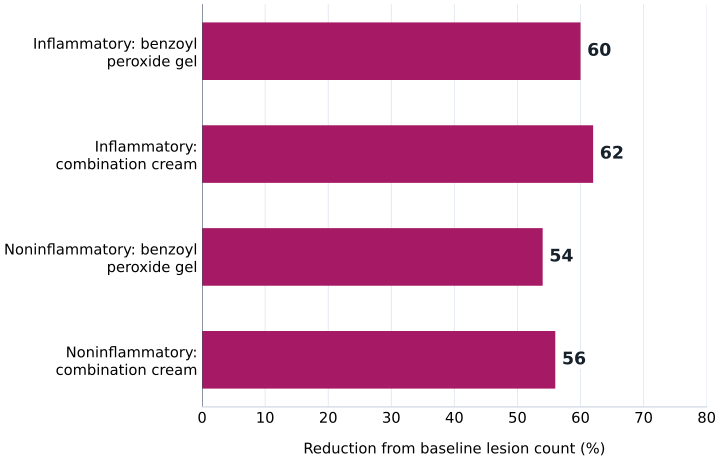
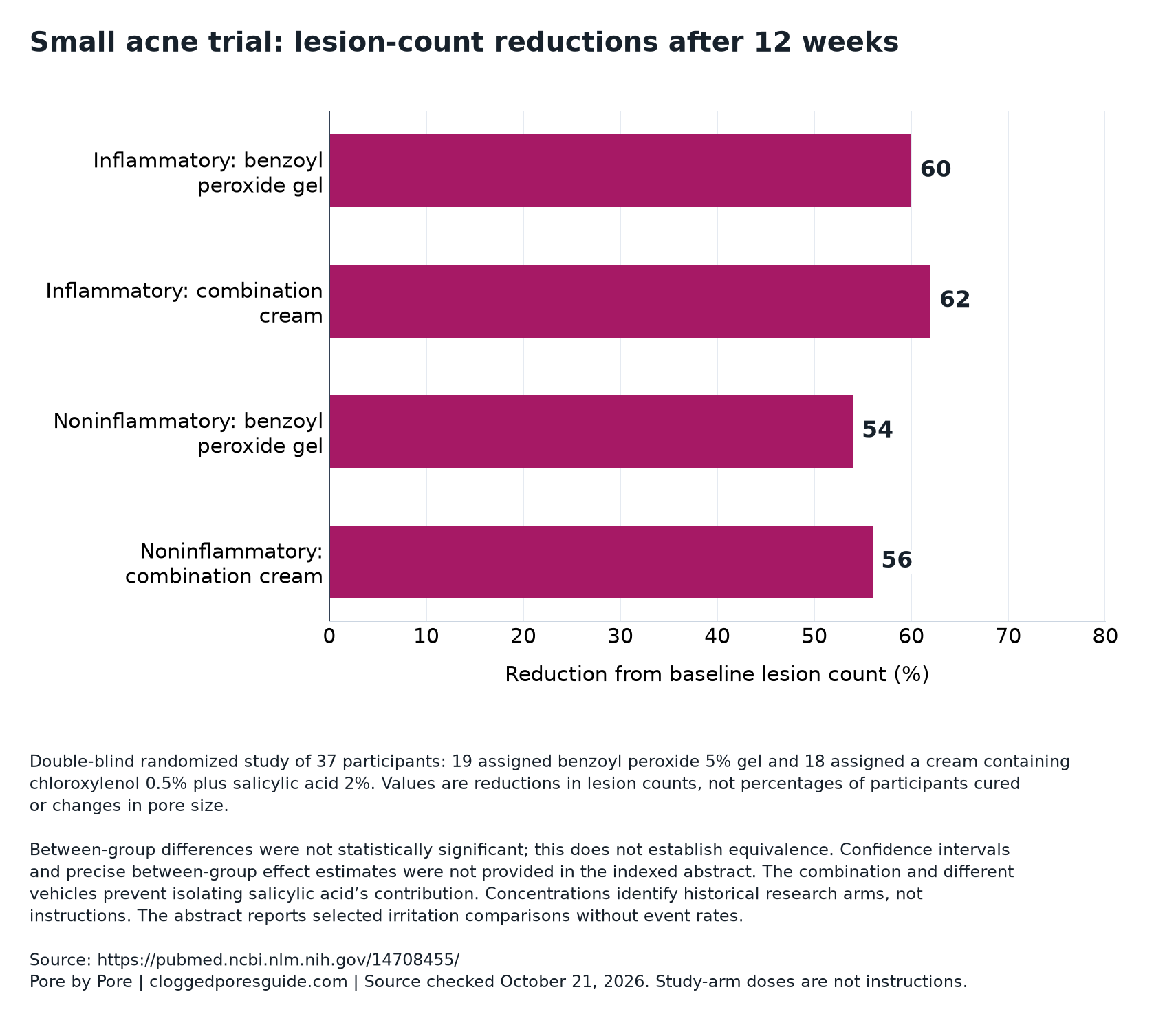
Reported lesion reductions: Inflammatory lesions decreased 60% with benzoyl peroxide and 62% with the combination; noninflammatory lesions decreased 54% and 56%, respectively. Source 1
Statistical boundary: No statistically significant between-group difference was reported, but the abstract does not establish formal equivalence or provide confidence intervals. Source 1
Tolerance finding: Erythema and photosensitivity were reported less often with the combination at week 12, but event frequencies were not supplied. Source 1
Pore claims remain separate: Acne-lesion counts and FDA acne-use conditions do not establish permanent changes in visible pore dimensions. Source 1 Source 2
What the 37-person experiment actually compared
The randomized, double-blind study assigned 19 volunteers to benzoyl peroxide 5% gel and 18 to chloroxylenol 0.5% plus salicylic acid 2% cream. Participants applied their assigned topical medication to the entire face twice daily for 12 weeks. These concentrations and application details identify the experimental arms; they are not a personalized regimen. Investigators obtained clinical evaluations and lesion counts at baseline and weeks 3, 6, 9, and 12.
The indexed abstract does not identify a single prespecified primary endpoint, explain the randomization procedure, or describe how masking was maintained between a cream and a gel. It also does not supply baseline lesion counts, age distribution, acne-severity distribution, participant flow, or sponsor information. An active comparator makes this a practical comparison between treatments, but without an untreated or vehicle-only group, it does not separately quantify either formulation’s benefit over its base or over the course acne would otherwise have taken.
The main study’s two treatment arms and reported week-12 results
| Study feature | Benzoyl peroxide arm | Combination cream arm |
|---|---|---|
| Assigned volunteers | 19 | 18 |
| Topical formulation | Benzoyl peroxide 5% gel | Chloroxylenol 0.5% plus salicylic acid 2% cream |
| Study exposure | Entire face, twice daily, 12 weeks | Entire face, twice daily, 12 weeks |
| Inflammatory lesion reduction | 60% | 62% |
| Noninflammatory lesion reduction | 54% | 56% |
Read the underlying chart data: download CSV or download the source-labeled chart.
Lesion counts answer a different question from pore dimensions
Inflammatory lesions include the papules and pustules counted in this report. Noninflammatory lesions are comedones, including blackheads and whiteheads. Reducing the number of comedones is a meaningful acne outcome, but it is not a measurement of the width, area, or visibility of pore openings. The study abstract reports no standardized pore imaging, pore-diameter measurements, scar outcomes, or proportion of participants who became completely clear.
That distinction matters when a product page places blackhead language beside a smaller-looking-pore promise. One outcome cannot silently substitute for the other. Our guide to visible pores versus blackheads explains the terminology. Editorial interpretation: the trial supports discussing counted acne lesions, not attaching a numerical pore-shrinking claim to salicylic acid. Whether fewer visible plugs would improve a person’s overall perception of their skin is a separate question requiring an appearance measure or a patient-reported assessment.
How to read the 60%, 62%, 54%, and 56% figures
At week 12, reported inflammatory-lesion reductions were 60% for benzoyl peroxide and 62% for the combination. Noninflammatory-lesion reductions were 54% and 56%, respectively. Each comparison therefore has a two-percentage-point separation in the reported reduction. That is not a finding that two additional people per hundred cleared, nor is it an absolute reduction of two lesions. The percentages describe changes in lesion counts, not the percentage of patients successfully treated.
For illustration only, a starting count of 50 inflammatory lesions would become 20 after a 60% reduction and 19 after a 62% reduction. This is arithmetic, not a reconstruction of the trial: actual starting counts and the precise averaging method are unavailable in the abstract. The example shows why baseline burden matters. Identical percentage changes can represent different numbers of lesions removed, and an average reduction does not reveal whether improvement was consistent across participants or concentrated among a few strong responders.
A nonsignificant difference does not establish equivalence
The report found no statistically significant between-group difference in papulopustule or comedone reduction. That means its statistical analysis did not establish a difference under the test used. It does not demonstrate that the formulations are interchangeable. Formal equivalence or noninferiority studies require a justified margin defining how much difference would matter, together with an analysis capable of evaluating that margin. Those elements are not reported in the accessible abstract.
With only 19 and 18 volunteers assigned, uncertainty deserves more attention than the small numerical gap. No confidence intervals are available to show the range of treatment differences compatible with the observations. The abstract also describes a somewhat stronger keratolytic, or surface-cell-shedding, effect with the combination, but supplies no numerical scale for that finding. Neither that description nor the two-percentage-point gaps establish superiority. The strongest supported summary is that both groups improved and this small comparison did not detect a difference in lesion reduction.
Why the cream cannot isolate salicylic acid’s contribution
The experimental cream contained two named active ingredients, chloroxylenol and salicylic acid, while the comparator contained benzoyl peroxide. The vehicles also differed: cream versus gel. Consequently, any difference could reflect active ingredients, the formulation base, their interaction, or other formulation characteristics. The study had no salicylic-acid-only arm and no matched cream without salicylic acid. It therefore cannot identify how much of the observed improvement was attributable to salicylic acid itself.
The same boundary applies when translating the result to a cleanser, toner, serum, compounded preparation, or another leave-on cream. Matching a percentage does not reproduce the tested formulation, exposure, or comparator. The product-format guide helps keep these distinctions visible. Editorial interpretation: a formulation-specific trial is most useful when the product and use context match closely; it is not a general performance certificate for every product sharing an ingredient name. This topical study also supplies no evidence for oral routes.
The tolerance result is real but incompletely quantified
At week 12, erythema—skin redness—and photosensitivity were reported significantly less often in the combination group. The reported P values were 0.0002 and 0.05, respectively. These are statistical results, not adverse-event percentages. A P value of 0.0002 does not mean that 0.02% of participants experienced redness. Without event counts, severity distributions, or confidence intervals, the abstract does not show the absolute size or precision of the tolerability advantage.
The result also belongs to the whole cream-versus-gel comparison, not necessarily to salicylic acid as an ingredient. The accessible report does not provide enough detail to evaluate discontinuations, persistence of reactions, or uncommon harms. A related study adding salicylic acid to another acne regimen reported more transient dryness, illustrating why a tolerance finding should not become a universal claim. Keeping benefits and discomfort in separate records, as discussed in the progress-record guide, avoids treating fewer lesions as proof that a formulation caused no irritation.
The 49-person addition study asked a different question
A separate 12-week prospective, single-blind randomized study enrolled 49 patients with mild to moderate facial acne. It compared salicylic acid added to clindamycin phosphate plus benzoyl peroxide against clindamycin plus benzoyl peroxide without that addition. Researchers assessed lesion counts, global improvement, quality of life, skin-barrier measures, and local side effects. Unlike the cream-versus-gel trial, this design directly asked whether adding a treatment to an existing combination improved results, although the abstract lacks enough formulation detail to isolate every possible difference.
The addition group had statistically greater inflammatory and total lesion reductions throughout the assessed study weeks and greater noninflammatory reductions beyond two weeks. Patient and investigator global assessments also favored it at the end. However, the abstract provides neither numerical effect sizes nor confidence intervals, and it does not state the salicylic acid concentration. Both groups had decreased outer-skin hydration; transient mild to moderate dryness was more frequent with the addition. Quality of life was assessed, but its result is not supplied. This antibiotic-containing regimen is not evidence for salicylic acid monotherapy or instructions for assembling a combination.
Three salicylic-related trials addressed different treatment questions
| Study design | Actual comparison | Interpretive boundary |
|---|---|---|
| 37 volunteers; randomized, double-blind; 12 weeks | Chloroxylenol/salicylic cream versus benzoyl peroxide gel | Two complete formulations; no isolated salicylic acid effect |
| 49 enrolled; randomized, single-blind; 12 weeks | Salicylic acid added to clindamycin/benzoyl peroxide versus the base regimen | Greater reported lesion improvement, but more transient dryness; effect sizes unavailable |
| 31 completers; randomized, open-label split-face; 28 days | Modified 2% supramolecular salicylic acid cream versus benzoyl peroxide/adapalene gel | Paired facial sides, not independent patient groups; short follow-up |
What split-face comparisons control—and what they leave unresolved
A third randomized study compared 2% supramolecular salicylic acid cream on one facial side with benzoyl peroxide/adapalene gel on the other for 28 days. Thirty-one patients completed this open-label, single-center study. Pairing treatments within a person helps control person-level differences that can complicate separate-group comparisons. But 31 people do not become 62 independent patients. Facial sides can differ initially, and the analysis must account for their pairing. Open labeling also leaves room for expectations to affect assessments.
At day 28, inflammatory-lesion reductions were 47.9% versus 49.8%, noninflammatory reductions 43.1% versus 42.7%, and total reductions 44.1% versus 45.6%. None of these comparisons was statistically significant; formal equivalence was not established. Enrollment and attrition details are unavailable. The abstract’s title and methods identify 0.1% adapalene, while its objectives text also says 0.01%, an unresolved discrepancy rather than independently confirmed dosing. Our split-face study analysis examines these paired results. The modified salicylic formulation and four-week duration prevent treating this as a replication of the 12-week combination trial.
FDA acne conditions are not individual product approval
FDA’s OTC topical acne monograph lists salicylic acid at 0.5–2% and benzoyl peroxide at 2.5–10%. Those ranges are part of a broader set of applicable conditions, not a stand-alone approval test. An ingredient percentage does not establish that a particular product meets every requirement, and monograph conformity is not product-specific FDA approval. The acne uses concern lesions, including blackheads and whiteheads, rather than permanent pore-size change. The order also warns that combining topical acne medicines can increase irritation and dryness.
FDA’s cosmetic BHA page provides a different context: salicylic acid is commonly called a beta hydroxy acid and is discussed in relation to exfoliation. Its historical discussion of an industry safety assessment is neither a new acne trial nor FDA product approval. Editorial interpretation: when reviewing a service offer, distinguish regulatory wording, formulation documentation, and contractual promises. The Likeness Rx review and SuperHealthy Rx review are places to check documentary terms, not evidence that either offers the studied formulation, condition-specific care, or these trial outcomes.
The safety questions small acne trials cannot settle
FDA distinguishes ordinary local irritation from rare serious hypersensitivity reported with some OTC acne products containing salicylic acid or benzoyl peroxide. Its historical review identified 131 reports through January 28, 2013, including 58 hospitalizations and 50 reports categorized as anaphylactic. These selected reports lack a denominator of exposed users, so they cannot yield a percentage risk. The responsible ingredient was not established: active ingredients, inactive ingredients, or both could have contributed.
FDA advises stopping the product and seeking emergency care for throat tightness, breathing difficulty, faintness, or swelling of the eyes, face, lips, or tongue. Small-area sensitivity checks do not guarantee that a later reaction will not occur. Meanwhile, the split-face study’s absence of significant between-side differences in hydration, transepidermal water loss, brightness, and erythema does not establish absence of irritation or long-term safety. Important unanswered research questions include durability after treatment ends, precise adverse-event frequencies, patient-valued improvement, and whether lesion-count changes correspond to a measured change in pore appearance.
Questions about the evidence
Does the main trial show salicylic acid works as well as benzoyl peroxide?
It shows that a chloroxylenol-plus-salicylic-acid cream and a benzoyl peroxide gel produced similar reported lesion reductions in a small comparison. It does not isolate salicylic acid, and a nonsignificant difference does not establish formal equivalence. The missing confidence intervals also prevent judging how wide the uncertainty around the treatment difference may be.
Could a 56% reduction in comedones mean pores looked 56% smaller?
No. Comedone reduction describes a change in the number of counted noninflammatory lesions. Pore width or area would require a separate measurement. Even complete removal of a counted plug would not, by itself, establish a proportional change in the surrounding pore opening. The trial did not report a visible-pore endpoint.
Why is the split-face study useful if it lasted only 28 days?
It provides a short-term comparison in which each participant receives both treatments on different sides. That controls many person-level differences, but it does not answer long-term questions, remove open-label bias, or create twice as many independent participants. Its modified salicylic acid cream also differs from the combination cream in the main trial.
Was the salicylic-containing option always better tolerated?
No. The main comparison reported less redness and photosensitivity with its combination cream at week 12, without event frequencies. The separate addition study reported more transient mild to moderate dryness when salicylic acid was added to clindamycin and benzoyl peroxide. Tolerability depends on the full formulation and regimen being compared.
What would make a future pore-focused trial more informative?
It would distinguish lesion counts from standardized measurements of pore appearance, report baseline burden and patient-valued outcomes, and provide confidence intervals and detailed adverse-event counts. Matched formulations could help isolate salicylic acid’s contribution. Longer follow-up would address durability, while a prespecified equivalence margin would be needed if interchangeability were the actual research question.
What this evidence supports
The 37-person study provides encouraging, formulation-specific evidence of acne-lesion improvement over 12 weeks. Its two treatment groups had closely spaced reported reductions, and the combination cream had favorable reported redness and photosensitivity findings. The defensible conclusion stops short of equivalence, salicylic-acid-only efficacy, or smaller pores. The addition and split-face studies broaden the evidence but answer different questions with different formulations, comparators, and follow-up periods. For Pore by Pore, the central interpretive rule is simple: retain the outcome’s original meaning. A counted blackhead is not a pore dimension, a statistical test is not an adverse-event rate, and an ingredient concentration is not proof that products are clinically interchangeable.
Research access and limitations
The clinical analysis is based on indexed primary study abstracts, not complete protocols, full statistical reports, or supplements. Confidence intervals, detailed adverse-event frequencies, and sponsor information were unavailable in those abstracts. Official FDA documents provide regulatory and safety context, not confirmation of efficacy for any individual commercial product.
Sources behind this reading
- Comparison of chloroxylenol 0.5% plus salicylic acid 2% cream and benzoyl peroxide 5% gel in the treatment of acne vulgaris: a randomized double-blind study. ↗Indexed primary study abstract · Checked October 21, 2026
- FDA OTC monograph M006: topical acne drug products ↗Official six-page administrative order, all sections read · Checked October 21, 2026
- Efficacy of the addition of salicylic acid to clindamycin and benzoyl peroxide combination for acne vulgaris. ↗Indexed primary study abstract · Checked October 21, 2026
- Efficacy and safety of 2% supramolecular salicylic acid compared with 5% benzoyl peroxide/0.1% adapalene in the acne treatment: a randomized, split-face, open-label, single-center study. ↗Indexed primary study abstract · Checked October 21, 2026
- FDA: beta hydroxy acids in cosmetics ↗Official FDA consumer background page, complete text read · Checked October 21, 2026
- FDA safety communication: serious hypersensitivity to some OTC acne products ↗Official FDA Spanish communication; entire safety notice and data summary read · Checked October 21, 2026